Characters – making them round.

I was disappointed. The writing seemed somewhat flat and the character remained distant. So, at the suggestion of the assignment, I retold the same scene using the present tense and from a first person perspective.

stick person, flat characterHow do you create ‘real’ characters? Characters that are round, not flat? Personalities that are interesting? People your readers care about?

For a recent Open University assignment, we were asked to write a scene using a stereotypical character, but showing the contradictions in the character in order to make him or her ’round’. I had in mind a suited business person, very successful, whose family life was a little less organised. I wrote the scene in the third person and past tense (the classic ‘literary’ story telling style).

I was disappointed. The writing seemed somewhat flat and the character remained distant. So, at the suggestion of the assignment, I retold the same scene using the present tense and from a first person perspective.

Here is my first attempt, written in the third person. Continue reading “Characters – making them round.”
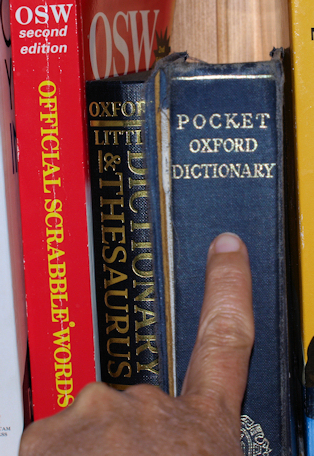
More new words

Recently, as part of my Open University course, ‘Start Writing Fiction’, I have been encouraged to look out for – and look up the meaning of – new words.

DictionaryI used to read a great deal when I was young. And I mean, a great deal. Between the ages of 10 and 14, I probably read at least a book a week, and at one point I was reading a book a day. Having worked my way through the children’s section of the library, I started on the adult sections.

Admittedly, I often did not understand what I was reading. Rarely did I bother to look up new words. I just kept on reading and, eventually, through the context of their settings, I would get to understand what a word meant, including its various nuances of meaning.

Nowadays, when reading modern fiction, I rarely come across a word I have never met before. But recently, as part of my Open University course, ‘Start Writing Fiction’, I have been encouraged to look out for – and look up the meaning of – new words.

So here are two words I came across this morning while reading Solar by Ian McEwan:


  1. proscenium: originally meaning the area under the arch in front of a stage in the theatre, now meaning the space between the front curtain and the first backdrop curtain. The word comes from the Latin and means ‘in front of the scenery’.


  2. amanuensis: a scribe or copier of manuscripts, someone who copies writing by hand. Originally it comes from the Latin for hand servant or slave of the hand, depending how literally you translate it.

Reading lately…

I have been reading furiously and have been too busy reading to write about reading.

  1. The Checklist Manifesto (non fiction book about the power and importance of checklists).
  2. Stephen King’s book of 4 shortish stories, Full Dark, No Stars
  3. Graham Swift’s Waterland – silt, mud and eels in the Fens.
  4. Sara Gruen’s Water for Elephants – absolutely compelling read and best book I have read for ages
  5. Ernest Hemingway’s To Have and Have Not – a strange and somewhat unpleasant book
  6. Solar by Ian McEwan is my latest read. I have to say, I am really enjoying this book (having struggled to enjoy the two previous Ian McEwan books). This one is very funny.

To Flashback or Not to Flashback

Personally, as a reader, I dislike the use of flashbacks. If the past was so important, why isn’t the story set then? If the past was not so important, why do I have to read about it?

On the Writer Unboxed blog, Jenna Blum advises avoiding flashbacks.

If what happened to the character in the past is that important, why not extract it and expand it so it becomes a consistent, reliable part of the book’s structure, instead of a temporarily distracting time bubble? Conversely: if the scene isn’t that important, why not condense it to a memory?

Personally, as a reader, I dislike the use of flashbacks. I find them disorienting and confusing. If the past was so important, why isn’t the story set then? If the past was not so important, why do I have to read about it?

This is one reason I found On Chesil Beach (by Ian McEwan) frustrating to read.

I have just finished Waterworld, by Graham Swift. A great book – BUT, I struggled to follow the various time threads. Not only does he tell his own personal history using jumps in time, but he interweaves the history of his family and history of the fictional fen location in which the book is set. In the end, he brought all the interwoven threads to a satisfactory merger and it came all together nicely at the end. However, with each dislocation in time, I felt a dislocation from the story (if that makes sense!). For me, it would have been a more compelling read without the distraction of the jumps, at least within his own history.

Just my opinion. Maybe I am a lazy reader?

Yippee – I have been accepted

“Why don’t you just write? You don’t need to do a course. Just write.”
I can write on my own; and I do. But how can I know what is good and bad. I am too close to the process

Photo of child doing some creative writingFollowing my disappointment with Nottingham University, I reappraised my options.

Had I set my sights too high applying for an MA in creative writing? Yes, almost certainly.

My husband said, “Why don’t you just write? You don’t need to do a course. Just write.”

But I feel that I do need a course. And I tried to explain to him why.

  • I need guidance. I can write on my own; and I do. But how can I know what is good and bad. I am too close to the process.
  • I need structure. Too often this happens; I sit down to write and get distracted – check Twitter and follow-up a few tweets, check my emails, look at my blogs, look at other people’s blogs, get onto Facebook, play Zuma Blitz …. You get the picture?
  • I want someone else to read my work with a critical eye and offer advice and suggestions. I want an audience.

So, what did I do since my last rejection?

  1. I applied to do a 12 week Creative Writing module (Start writing fiction) at the Open University
  2. I registered for a couple of days ‘Writing Great Short Stories’ course at Knuston Hall
  3. I applied to Birkbeck University, part of the University of London, for a place on their BA in creative writing

My interview at Birkbeck took place last Monday. I had 15 minutes to persuade two very young lecturers that I was a suitable candidate. They sent me an email on Wednesday, informing me I had been accepted. Yippee. Can’t wait!