#Amwriting

amwriting badgeRecently joined the #amwriting Web site. This seems like a friendly group of writers, many with published books, who all congregate around the Twitter hashtag #amwriting.

Probably the last thing I need is yet another blog! But it is good to be part of the writing community.

FridayFlash button
I have also recently discovered the Friday Flash site. This looks like another good idea and something to add to my list of writing challenges.

Characters – making them round.

I was disappointed. The writing seemed somewhat flat and the character remained distant. So, at the suggestion of the assignment, I retold the same scene using the present tense and from a first person perspective.

stick person, flat characterHow do you create ‘real’ characters? Characters that are round, not flat? Personalities that are interesting? People your readers care about?

For a recent Open University assignment, we were asked to write a scene using a stereotypical character, but showing the contradictions in the character in order to make him or her ’round’. I had in mind a suited business person, very successful, whose family life was a little less organised. I wrote the scene in the third person and past tense (the classic ‘literary’ story telling style).

I was disappointed. The writing seemed somewhat flat and the character remained distant. So, at the suggestion of the assignment, I retold the same scene using the present tense and from a first person perspective.

Here is my first attempt, written in the third person. Continue reading “Characters – making them round.”

More new words

Recently, as part of my Open University course, ‘Start Writing Fiction’, I have been encouraged to look out for – and look up the meaning of – new words.
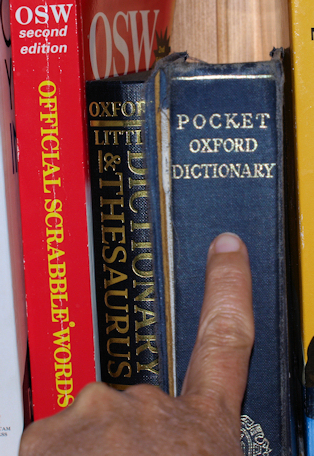
DictionaryI used to read a great deal when I was young. And I mean, a great deal. Between the ages of 10 and 14, I probably read at least a book a week, and at one point I was reading a book a day. Having worked my way through the children’s section of the library, I started on the adult sections.

Admittedly, I often did not understand what I was reading. Rarely did I bother to look up new words. I just kept on reading and, eventually, through the context of their settings, I would get to understand what a word meant, including its various nuances of meaning.

Nowadays, when reading modern fiction, I rarely come across a word I have never met before. But recently, as part of my Open University course, ‘Start Writing Fiction’, I have been encouraged to look out for – and look up the meaning of – new words.

So here are two words I came across this morning while reading Solar by Ian McEwan:


  1. proscenium: originally meaning the area under the arch in front of a stage in the theatre, now meaning the space between the front curtain and the first backdrop curtain. The word comes from the Latin and means ‘in front of the scenery’.


  2. amanuensis: a scribe or copier of manuscripts, someone who copies writing by hand. Originally it comes from the Latin for hand servant or slave of the hand, depending how literally you translate it.

New word: Numismatics

money This was a new word for me: numismatics, the study of coins.
And the related word numismatists, people who study or collect coins.

I found this word in one of Stephen King’s short stories (just finished reading Full Dark, No Stars) and was surprised I had never come across it before, despite coin collectors being commonplace. If I had to guess the meaning, I would have guessed it had something to do with numbers or maths. I suppose coins are connected to numbers.

No Bridge Over Troubled Waters

Walking along the South Bank with my daughters, I mused on how much history and how many iconic landmarks were contained within a few short yards. When I decided to write a flash fiction piece, this little story (and the linkages) just seemed to pop into my head.


They agreed to meet at London Bridge and make another attempt to cross the gulf that separated them.

Walking along the South Bank, they made slow progress. The same arguments were replayed; until, outside The Globe, she responded dramatically – as she always did – leading to a public exhibition of tears and tantrums on the steps of The Tate.

He accused her of being theatrical and she shed more tears as they walked past The National and accused him of orchestrating their disharmony – in full view of the queue outside the Royal Festival Hall.

Eventually she managed to govern her emotions, but not until they reached the facade of the old County Hall. By then it was too late. Things had moved on, he said. He decreed they would never see eye-to-eye if they kept circling round in the same old way. As his opposition hardened, she came to the realisation there were some bridges that could not be mended.

At Westminster Bridge they agreed to stop battling against the tide. The time for negotiation had passed.

By unanimous decision, on reaching Parliament Square, they elected to go their separate ways.


Here is the walk: