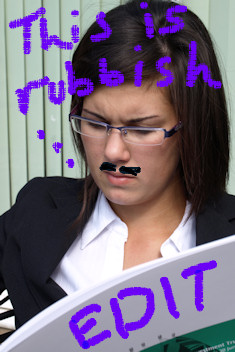
Internal Editor – I’m trying to gag her

Last year, when I didn’t know what I was doing and started from scratch with a character, from which a story just evolved, it was easier to gag that bitch of an Internal Editor. If she started saying “that’s not good enough” or “rubbish!” or “call yourself a writer, this is a joke?” – I could just give her a kick.

Internal editor saying - this is rubbishDoing NaNoWriMo this year, I am having far more trouble with my internal editor this year compared to last year.

Probably, the reason is this: I have invested far more time and effort into the NaNo novel this time and have great expectations of myself. This story matters to me. So I don’t want to mess it up.

Last year, when I didn’t know what I was doing and started from scratch with a character, from which a story just evolved, it was easier to gag that bitch of an Internal Editor. If she started saying “that’s not good enough” or “rubbish!” or “call yourself a writer, this is a joke?” – I could just give her a kick and retaliate by saying: “fair enough, but not bad for a total beginner with no time to plan or think”.

This year, not only have I have had time to plan and think through the NaNo book, but in the past 12 months, I have studied the art of writing. I have bought and read books on writing, harvested the internet for sites that teach writing skills, done some critical reading, completed the Open University course “Starting to Write Fiction“, and dragged myself from a state of nearly complete ignorance to one of self-conscious self-awareness.

So, there is more at stake this year. I am no longer a beginner. I have even written one short story that has won a prize and will be published shortly.

My internal editor has thrived on all this extra knowledge. The more you know about how to do it right, the more you see your own mistakes. She is whispering in my ear, constantly, advising me to choose a different word, change that sentence there, revise that paragraph, alter that section and, on a really bad day, telling me to get rid of that chapter completely.

At this rate, I will finish NaNoWriMo in January 2042. Not only will I, in all probability, be dead by then but – as all NaNoWriMos know – that kind of timescale does NOT count as a NaNoWriMo win!

So, back to my Internal Editor. Any tips on how to gag her?

NaNoWriMo – better late than never

NaNoWriMo this year? Easy-peasy. Bring it on! Hmmm. When things seem like they are going to be almost too easy, you can bet they probably are not going to be as easy as all that.

Writing planner - Ruth LivingstoneI was really organised in the build up to NaNoWriMo this year.

I had the story all planned in my head with the characters fully formed and the plot outline in place. I knew who was going to do what and when. I had to stop myself starting the damn book in September, so enthusiastic and ready to go was I.

So, NaNoWriMo this year? Easy-peasy. Bring it on!

Hmmm. When things seem like they are going to be too easy, you can bet they probably are not going to be as easy as all that.

Had a huge piece of work to prepare for and didn’t get going on the 1st November. No problem. Last year, I started a few days late and soon caught up. Then a work colleague went off sick. Then another one. Then I got sick too – fever, sore throat, aching limbs, diarrhoea, hacking cough with retching (you really did want all of this detail didn’t you?).

Finally started on the 6th November. Shame on me. Now playing catch up like mad. And having terrible problems with my internal editor. Will tell you about her another time …. but for the moment, please excuse me – I have another 2,000 words to bang out before tea time.

Difficult assignment

Difficult homework assignment.

How about this for a tricky bit of writing homework:

Rewrite the Hemingway story Hills Like White Elephants in the style of Gabriel García Márquez’s The Handsomest Drowned Man in the World.

Hemingway’s prose is sparse and factual. For the most part, his story consists of dialogue between two people while waiting for a train. Márquez’s narrative is dense and mainly descriptive, told in the style of a fable or legend.

My task, therefore, was a difficult one. However, having spent most of a sunny Saturday afternoon struggling with it, I was quite pleased with the outcome. But my story seemed unfinished. I went back on Sunday and added an extra scene. This gave the story a better ending, but changed the theme into something a little different from the original Hemingway one.

Now, my next piece of homework: to rewrite the Márquez story in the style of AL Kennedy’s story, A Bad Son …..

Punctuation made simple (and funny….)

Who would believe a book on punctuation could be so amusing? If you have ever been stumped by the apostrophe, confused by the colon, or dithered over the humble dash – this book is for you

eats-shoots-and-leaves by Lynne Truss, recommended as a book for writers by Ruth Livingstone Just finished reading Lynne Truss’s wonderful book: Eats, Shoots and Leaves.

Who would believe a book on punctuation could be so amusing?

I wish my English teacher had the same entertaining style and ease of expression. If you have ever been stumped by the apostrophe, confused by the colon, or bewildered by the humble dash – this book is for you. Continue reading “Punctuation made simple (and funny….)”

I passed!

Open University – Start Writing Fiction Course. Three months of reading, writing and thinking – with two assignments to submit – kept me busy. Some of it was easy. Some of it was challenging.

happy faceYes, I passed the Open University course. Yippee!

This was the Start Writing Fiction Course, A174, and counts for 10 credits. Three months of reading, writing and thinking – with two assignments to submit – kept me busy. Some of it was easy. Some of it was challenging.

Worth doing? Yes. Definitely.

One of the fun things about the course was the student forums. Our own ‘Tutor Forum’ was poorly attended, which was a shame. The course would have been greatly enriched with more active participation. There were four or five of us who regularly contributed and I am sure we got far more from the course by posting work, discussing others’ work, asking questions and sharing difficulties.

There was, however, an active Sudents’ Cafe. This was a forum where everybody from any tutor group could participate and it was a lively place.

Many of the A174 students are going on to do the Open University’s A215 course, Creative Writing, (worth 60 credits). Sadly, I am not one of them. But I hope to keep in touch with the friends I have made. And, I am looking forward to starting at Birkbeck in October.