NaNoWriMo – over but not done.

My NaNoWriMo book, provisionally entitled The Bounty Hunter, had an extensive pre-writing phase. With over 50,000 words, I am only half way through the story. I guess that at least gives me plenty of scope for removing great tracts of gibberish in the re-writing phase

nanowrimo 2011 winner badgeYes, I made the final word count submission and I am a NaNoWriMo winner.

This is the second year I have taken part and the second year I have completed the 50,000 word count. The half-finished novel from 2010 lies, neglected, in the depths of my PC. I always meant to finish it, but never quite plucked up the enthusiasm to do so. And, since the novel just kind of grew from a character description, I suspect it would take a great deal of work and many months of complete re-writing to get a decent novel out of its rambling paragraphs.

This year, I started with a definite plan and a complete story in my head. It is a science fiction story that I have been mulling over for a couple of years and the main characters and plot line were fully in my mind before I started typing this November.

I just finished reading Amanda Boulter’s book; Writing Fiction: Creative and Critical Approaches. In this, she describes the three phases of writing – pre-writing, followed by writing, followed by re-writing.

My current NaNoWriMo book, provisionally entitled The Bounty Hunter, had an extensive pre-writing phase. Having written over 50,000 words, I am only half way through the story, as outlined in my head. I guess that at least gives me plenty of scope for removing great tracts of gibberish in the re-writing phase.

The worst thing I could do at this stage is quietly forget about it. Having invested two years of pre-writing and nearly a month of writing, I must take it further and finish the writing phase. The good news is that I have indeed worked on the document since NaNoWriMo ended – and, so far, I have resisted the terrible urge to start at the beginning and edit the whole thing. I need to finish the damn story first, then I can work on making it better and see if I have come out with a worthwhile novel at the end.

NaNoWriMo – final countdown

With a bit of luck, I will get a few thousand words done on Monday and Tuesday and be able to submit for the word-count-hickory-thingy on NaNoWriMo Web site by Wednesday morning. Great achievement!

On the downward slope now, heading for the magic 50,000 words, full steam ahead.

I have a day, tomorrow, when I am unlikely to be able to write much, as I have a work commitment. Yes, I know it is a Sunday!

With a bit of luck, I will get a few thousand words done on Monday and Tuesday and be able to submit for the word-count-hickory-thingy on NaNoWriMo Web site by Wednesday morning. What a great achievement, considering I started so damn late in the month.

I do have a problem though. With 50,000 words nearly done, I am less than half of the way through my novel. Either I have written too much in the first part, or it is going to be a very long book. Reading back through some of the chapters (and, yes, I know you aren’t supposed to do this during NaNo), I spend a lot of time explaining stuff. That is one of the problems with Sci Fi, you feel compelled to explain the quasi-scientific background to some of the devices you employ – like how exactly you travel at faster-than-light speeds through sub-space or, the faster variation, between systems by quantum leaping.

Anyway, editing the thing down to a reasonable size is for another month. This month has only four days left. Write, write, write …..

The ups and downs of NaNoWriMo 2011

Today I met up with three other local NaNo participants. We enjoyed a cup of coffee together at the Great Northern Hotel in Peterborough and, importantly, we did a solid two and a half hours of writing.

national novel writing month participant badge for 2011Well, I have nearly caught up with my NaNoWriMo word count. After a few days of hectic writing, I am only 3000 or so words behind where I should be.

Today I met up with three other local NaNo participants. We enjoyed a cup of coffee together at the Great Northern Hotel in Peterborough and, importantly, we did a solid two and a half hours of writing. One of our members had finished her 50,000 words already, and spent the time planning her novel in her notebook. She writes different scenes in a non-consecutive manner and her task in the next few weeks will be to assemble what she has done into some sort of order.

I write sequentially. Although, in a bid to actually finish my novel, I am tempted to follow some of the ‘pep-talk’ advice supplied by Chris Baty. He suggests finishing the novel, even if there are sections you have not fully fleshed out during the NaNo month. With the ending down on paper, you have at least a finished story to start playing with.


Progress in the NaNo month has been up and down for me. Actually, mainly down, as this nifty NaNoWriMo calendar widget demonstrates. The red colour, in case you haven’t guessed, is bad!

Anyway: onward and forward. Keep writing.

And this year, I promise myself I will finish the damn thing.

Internal Editor – I’m trying to gag her

Last year, when I didn’t know what I was doing and started from scratch with a character, from which a story just evolved, it was easier to gag that bitch of an Internal Editor. If she started saying “that’s not good enough” or “rubbish!” or “call yourself a writer, this is a joke?” – I could just give her a kick.

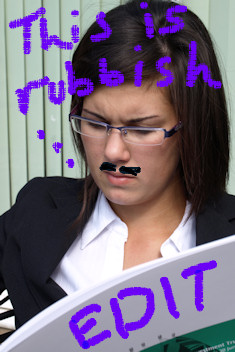
Internal editor saying - this is rubbishDoing NaNoWriMo this year, I am having far more trouble with my internal editor this year compared to last year.

Probably, the reason is this: I have invested far more time and effort into the NaNo novel this time and have great expectations of myself. This story matters to me. So I don’t want to mess it up.

Last year, when I didn’t know what I was doing and started from scratch with a character, from which a story just evolved, it was easier to gag that bitch of an Internal Editor. If she started saying “that’s not good enough” or “rubbish!” or “call yourself a writer, this is a joke?” – I could just give her a kick and retaliate by saying: “fair enough, but not bad for a total beginner with no time to plan or think”.

This year, not only have I have had time to plan and think through the NaNo book, but in the past 12 months, I have studied the art of writing. I have bought and read books on writing, harvested the internet for sites that teach writing skills, done some critical reading, completed the Open University course “Starting to Write Fiction“, and dragged myself from a state of nearly complete ignorance to one of self-conscious self-awareness.

So, there is more at stake this year. I am no longer a beginner. I have even written one short story that has won a prize and will be published shortly.

My internal editor has thrived on all this extra knowledge. The more you know about how to do it right, the more you see your own mistakes. She is whispering in my ear, constantly, advising me to choose a different word, change that sentence there, revise that paragraph, alter that section and, on a really bad day, telling me to get rid of that chapter completely.

At this rate, I will finish NaNoWriMo in January 2042. Not only will I, in all probability, be dead by then but – as all NaNoWriMos know – that kind of timescale does NOT count as a NaNoWriMo win!

So, back to my Internal Editor. Any tips on how to gag her?

Ray Bradbury writes about writing.

Farewell Summer ends with an Afterword, in which Ray Bradbury writes about his approach to writing. Fascinating stuff. I have just selected a few nuggets. If you want more, you will have to read the book yourself.

Ruth Livingstone blog post.
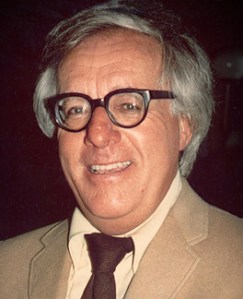
Photo of Ray Bradbury by Alan Light
I have just finished reading Farewell Summer, by the great master, Ray Bradbury.

(If you are interested in my thoughts about this novel, read my review on Ruthless Reading)

The book ends with an Afterword, in which Ray Bradbury writes about his approach to writing. For me, this was fascinating stuff. I have just selected a few nuggets from the Afterword. If you want more, you will have to Continue reading “Ray Bradbury writes about writing.”